

Chimney repairs & rebuilds
Chimney rebuilds, repointing, flaunching, flashings and cowl fitting. Stacks take more weather than any other part of a roof, and they are usually the first thing to let water in.
- Repointing and full rebuilds
- Lead flashings and soakers
- Cowls, caps and removals
- Fully insured, scaffolded access

400+ Five-star reviews
Across Google, Checkatrade, TrustATrader & MyBuilder
30+ Years of experience
Roofing and exterior property care across the capital
25 yr Guarantee
Backed by premium materials and skilled workmanship
Free No-obligation quotes
Clear, itemised pricing with no hidden costs


Why chimneys fail
Exposed on every side, and usually forgotten
A chimney stack is the only part of a house that gets rain on all four faces, dries out fastest, freezes first and has a hole running down the middle of it. It is unsurprising that mortar joints erode, flaunching cracks and pots work loose — what is surprising is how rarely anyone looks at one until damp appears on the breast downstairs.
Most chimney damp comes from one of four places: eroded pointing letting water into the brickwork, cracked flaunching around the pots, failed lead where the stack meets the roof, or a redundant flue with no ventilation and no cap. We check all four rather than fixing whichever is easiest to reach.
- Pointing, flaunching and lead all assessed
- Redundant flues capped and ventilated
- Pots re-set or replaced where loose
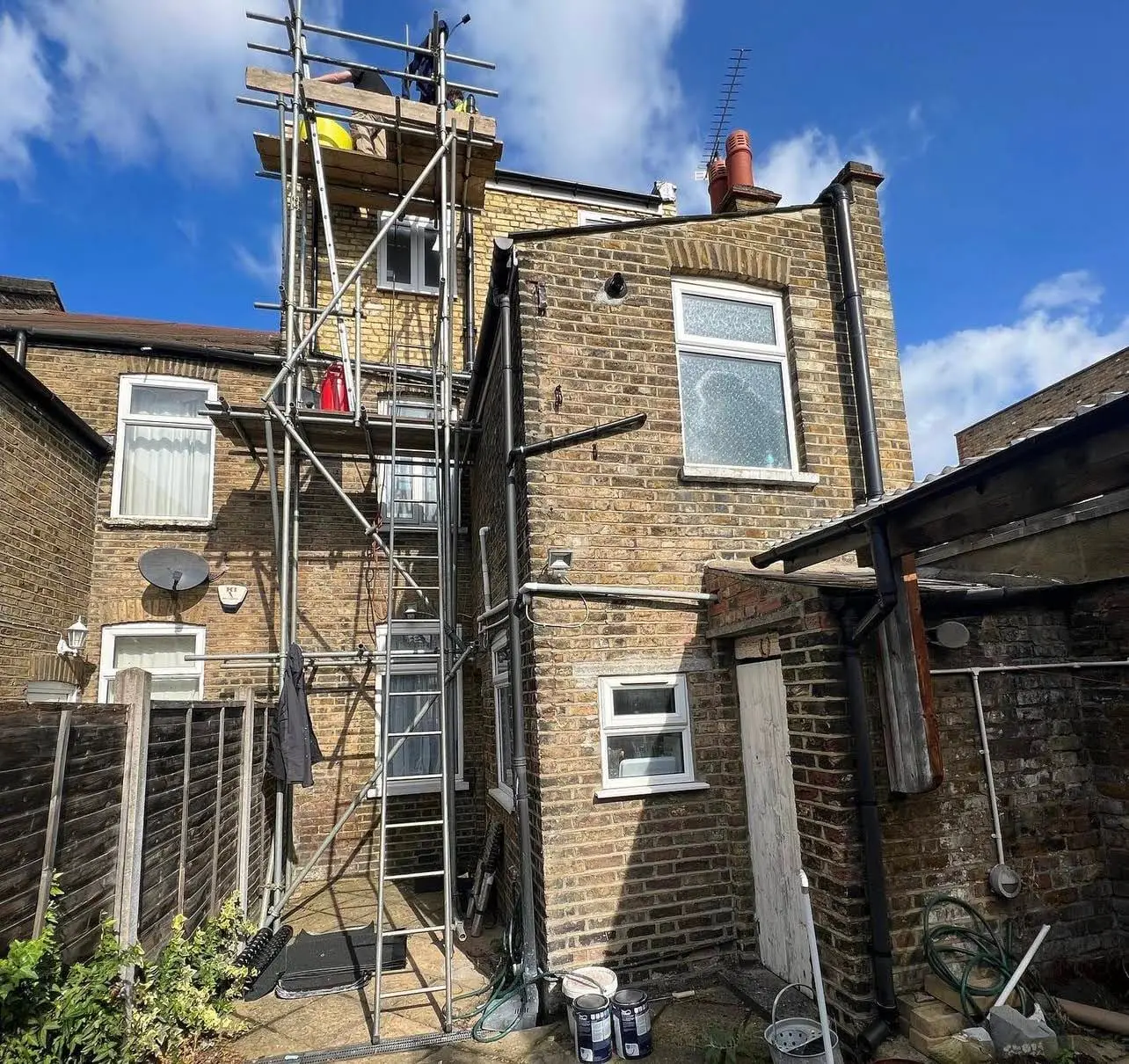
- Scaffolded access, never worked off a ladder
What we do
Chimney work from pointing to rebuild
Whether the stack needs an afternoon or a week, the same team handles the brickwork and the leadwork together.
Repointing
Eroded joints raked out and repointed in a mix suited to the original brickwork, not a hard modern mortar that traps damp.
Flaunching
The mortar bed around the pots cut out and re-formed with a proper weathering fall so water runs off rather than in.
Rebuilds
Stacks taken down to a sound course and rebuilt where the brickwork has spalled, leaned or cracked beyond repointing.
Lead flashings
Front aprons, stepped flashings, soakers and back gutters re-formed as a set so the whole junction works together.
Cowls & caps
Cowls to keep rain and birds out of a working flue, and vented caps for flues that are no longer in use.
Removals
Redundant stacks taken down and the roof made good and weathertight across the opening.
What to look for
Signs your chimney needs attention
Chimney trouble usually shows up as damp inside long before anything looks wrong outside.
- Damp patches or staining on the chimney breast indoors
- A tide mark that darkens after wind-driven rain
- Mortar joints visibly eroded or missing between bricks
- Cracked flaunching, or pots that look loose or tilted
- Brick faces flaking and crumbling away
- A stack that has developed a visible lean
- Mortar and grit collecting in the gutters below
Loose brickwork or a leaning stack over a public footpath should be looked at quickly — call us rather than emailing.

How it works
Five steps, no surprises
The same straightforward process whether you need a single tile replaced or an entire roof rebuilt.
- 01
Get in touch
Call, email or WhatsApp us with what you have noticed. We will ask a few questions to understand the property and how urgent it is.
- 02
Free inspection
We come and look properly — including up on the roof where it is safe to do so — and photograph anything that needs your attention.
- 03
Written quote
You receive a clear, itemised quotation explaining the work, the materials and the price. No obligation, no pressure.
- 04
The work
Our own team carries out the job to the agreed programme, keeping you updated with photos and leaving the site clean each day.
- 05
Sign-off & guarantee
We walk you through the finished work, share before-and-after photos and confirm the guarantee that applies to your job.
Chimney Work FAQs
Your questions, answered
The questions we get asked most about this work. If yours isn't here, just ask — we're happy to explain.
How much does chimney work cost?
It depends on the stack and on access, which is often the biggest single factor — a chimney in the middle of a roof slope needs more scaffolding than one on a gable end. Repointing is at the lighter end, a full rebuild at the heavier. We look before we quote, and the quotation is itemised so you can see the access cost separately.
Do I need scaffolding for chimney work?
For anything beyond a very quick inspection, yes. Chimney work is not something to do off a ladder, both for safety and because the quality of the work depends on being able to reach all four faces properly. Access is included in your written quote.
Should I remove a chimney I no longer use?
Not necessarily. A capped, ventilated stack costs very little to maintain and keeps the appearance of the building, which matters on a period terrace. Removal makes sense where the stack is structurally poor or where it is causing recurring problems. It is worth taking advice before deciding, particularly on a shared party stack.
Why is my chimney breast damp when the fire is not used?
Usually because the flue is open at the top and unventilated at the bottom, so moisture condenses inside it, or because water is getting in through eroded pointing or cracked flaunching. An unused flue should be capped at the top and vented at the bottom so it can breathe.
Can you match the brickwork on a period property?
We source bricks and mix mortar to suit the original as closely as we can, using a lime-based mix where the building calls for it rather than a hard cement mortar that will trap moisture and damage soft old bricks.
Do you also sweep chimneys or line flues?
No — we cover the structure and weathering of the stack rather than the flue itself. For sweeping or lining a working flue you will want a specialist, and we are happy to say so rather than take on work outside what we do.

Free quote
Damp on the chimney breast?
We will inspect the stack properly, photograph what we find and quote for putting it right — free and with no obligation.